 Cookies
SaaS MVP Development: A Founder's Guide
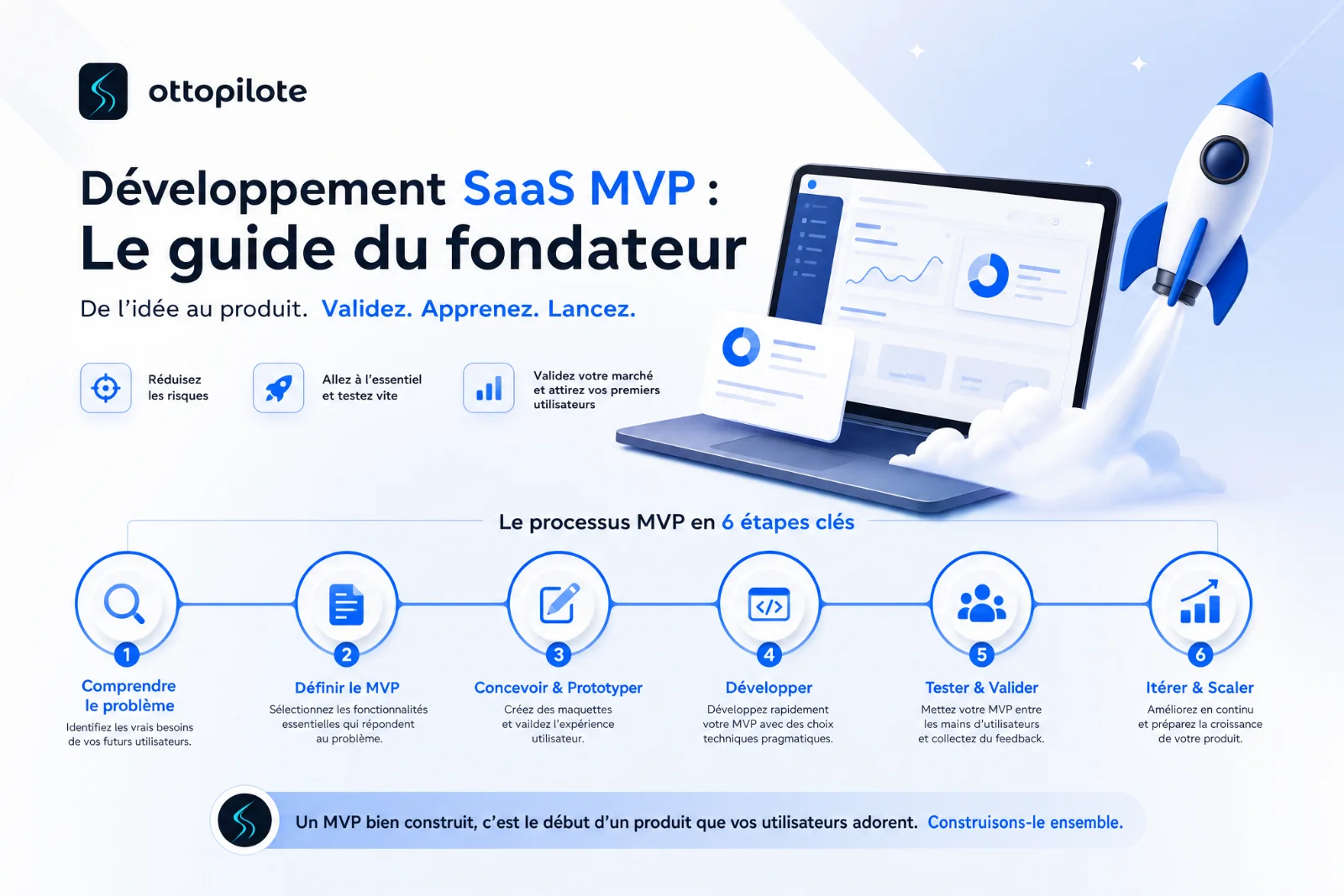
SaaS MVP development takes one validated workflow from idea to a live product real users can pay for. It starts with a frozen scope: what ships in v1, what waits. At OTTOPILOTE, an MVP ships in 4 to 6 weeks and a full production SaaS in 8 to 12 weeks. The scope you cut before sprint 1 protects the budget and the timeline more than the speed of the team.




Most founders don't fail at SaaS MVP development because their idea is wrong. They fail because they build too much, too soon — and by the time real users arrive, the product no longer reflects what the market actually needs.
This guide is for non-technical founders who want a clear, honest picture: what a SaaS MVP is, how you build one step by step, what it realistically costs, and how long it takes. We also reference a real case — Odiwise — to show what "minimum viable" looks like in real use, before the product is even finished. If you're weighing whether to build custom or use an existing tool, our complete guide to custom software development comparison runs through the trade-offs in detail.
🧩 What is a SaaS MVP?
An MVP — Minimum Viable Product — is a product with core features but nothing more: enough to solve one real problem for real users, but stripped of everything that can wait for v2. Applied to SaaS, two constraints are non-negotiable from day one: cloud infrastructure and multi-tenant architecture. Every user gets their own data space; the platform serves many accounts without being rebuilt for each.
The distinction that matters most is MVP vs prototype. A prototype demonstrates an idea — it cannot be used in production, no data is persisted, and no billing is possible. An MVP is production-ready: users log in, real transactions happen, and you can charge for access. The prototype asks “is this the right idea?” The MVP answers “does it create real value?”
This gap — feature completeness versus real user learning — is where most early-stage SaaS products fail. Founders try to build everything before launch, convinced that more features equal more value. The opposite is true. Every feature you add before launch is a hypothesis about what users need. Every feature you withhold is a bet you’ll learn faster by shipping. An MVP is the smallest thing you can charge for — and charging is what makes learning real.
For SaaS specifically, the MVP must also establish foundational architecture: user authentication with tenant isolation, a recurring billing mechanism, and cloud hosting with CI/CD in place. These aren’t optional extras — they are the scaffolding that makes future iteration possible without rebuilding from scratch. Eric Ries’ Lean Startup coined the term and made the case for building to learn, not to finish.
🚀 Why build an MVP first?
For a non-technical founder, the case for building an MVP first comes down to three things: cost, risk, and time to first revenue.
Cost. A full SaaS with every feature you’ve imagined sits at the top of our range for a full product (€25,000 to €100,000 and up), or beyond it. An MVP with the core loop only costs a fraction of that. The money you don’t spend on unvalidated features is money available for the right iterations after launch.
Risk reduction. Every month you spend building before you talk to paying users is a month where the assumptions underlying your product might be quietly wrong. An MVP flushes out wrong assumptions fast — and cheaply. Once real users are using the product, you know what they actually do (not what they say they’ll do), and you can build the next sprint around evidence, not guesses.
Time to first revenue. Investors and accelerators want to see traction: users who pay. An MVP gets you to that evidence faster than a full build — typically by months. The first paying customer is worth more than any feature list in a pitch deck.
Building the wrong feature set — even perfectly — is the most expensive mistake in SaaS. Six months of engineering at €600–€900/day per developer, then scrapping a module because users never wanted it, costs as much as three well-scoped MVPs. The scope decision is the financial decision.
Non-technical founders sometimes worry that an MVP will look “unfinished” and lose credibility with users. The opposite is almost always true: users respond better to a tool that does one thing exceptionally well than a complex product that does ten things poorly.
📦 What SaaS MVP development includes (and what it doesn’t)
SaaS MVP development is not a smaller version of a full product build. It is a different scope, with a different definition of done.
What’s included
- One core workflow, end to end, in production — not a clickable mockup
- Real authentication with tenant isolation, real data storage, real deployment
- Billing, so that users can pay from day one
What’s deliberately left out
- Secondary workflows, however obvious they look
- Integrations beyond one: two integrations together add 4 to 6 weeks (see the timeline chart below)
- Admin panels, reporting dashboards, notifications and analytics beyond what proves the core workflow works
One exception: compliance. When GDPR or HIPAA applies to the data you handle, it is not optional and cannot wait for v2. It adds 2 to 4 weeks and belongs in the v1 scope from the start.
The test is simple: if a feature can be removed without stopping a user from completing the core workflow and paying for it, it does not belong in the MVP. That line is what keeps a launch inside 4 to 6 weeks.
🛠️ SaaS MVP development process, step by step
Building a SaaS MVP follows a repeatable five-step process. Understanding each step lets you ask the right questions of any team or agency you work with.
Step 1 — Target market and problem definition
Before any design or code, you need a one-sentence statement that names the user and their problem. “Freelance HR consultants who invoice 15+ clients a month and lose time chasing late payments” is a target market. “HR professionals” is not. This definition shapes every scoping decision that follows.
Step 2 — Scope core features with MoSCoW
The MoSCoW method sorts features into Must-have, Should-have, Could-have, and Won’t-have. For an MVP, you build only the Must-haves. The discipline here is merciless: if a feature isn’t required to complete the core user loop, it goes in the backlog. Everything from the “Should” column downward waits for v2. The output of this step is a functional specification short enough to fit on a single page.
Step 3 — Cloud-native architecture from day one
A SaaS MVP is not a monolithic web app. From day one it needs: multi-tenant data isolation (each customer’s data separated), a scalable cloud deployment (AWS, GCP, or Azure), and automated CI/CD pipelines so updates ship without downtime. The AWS Well-Architected Framework for SaaS defines these structural requirements in detail. Skipping this creates technical debt that costs 3–5× more to fix later than to build correctly upfront.
Step 4 — Build with full-stack squads
Modern SaaS MVP teams are small and cross-functional: one or two full-stack engineers, a designer, and a product lead. Sprints run one to two weeks, each ending with a working build and a demo. Full-stack engineers move across front-end, API, and database layers — which minimizes handoff delays in small teams. This is what good custom SaaS development looks like in practice: no long design phase before code, no code before validated scope.
Step 5 — Launch and measure
Launching means getting the MVP in front of real users — paid or not — and measuring what they do. Define two or three key metrics before launch: activation rate (do users complete the core loop?), retention (do they return?), and conversion (do they pay?). The first post-launch sprint is not about adding features. It’s about reading the data and deciding what to build next based on what users actually did.
The Odiwise example. Odiwise is financial audit software for real estate projects, built to replace heavy analyses scattered across spreadsheets. The build isn’t finished yet, but the client didn’t wait for it: the parts already working are in use and save time on analyses that used to take hours. Before the software is even complete, the client has pre-sold it to a first buyer. It is a clean example of shipping the core first and letting real use, and a real sale, validate what comes next.
✓ Named user + defined problem · ✓ MoSCoW scope frozen before sprint 1 · ✓ Multi-tenant cloud architecture in place · ✓ Full-stack squad with weekly demos · ✓ 2–3 metrics tracked from launch day.
⏱️ How long does it take?
At OTTOPILOTE, a SaaS MVP is delivered in 4 to 6 weeks, and a full production SaaS in 8 to 12 weeks. Those timelines come with conditions, and they are real constraints — not a disclaimer buried in the fine print.
Four to six weeks assumes: a frozen scope before sprint 1 begins; fast client-side feedback (no waiting a week for design approval); no compliance requirements (GDPR, HIPAA, and SOC 2 each add weeks); and no third-party API integrations with unreliable or poorly documented endpoints.
The variables that stretch timelines are not mysterious: unclear scope, slow validation loops, third-party integrations, and compliance requirements. All four are manageable — if you identify them at scoping, not mid-sprint.
🗓️ What a SaaS MVP development timeline actually looks like
The published timeline is 4 to 6 weeks for an MVP and 8 to 12 weeks for a full production SaaS. Here is what happens inside it, in order, and what you have in hand at the end of each phase.
| Phase | What happens | What you have at the end |
|---|---|---|
| Scope | Target user and problem, MoSCoW prioritisation, v1 scope frozen | A functional specification that fits on one page |
| Architecture | Multi-tenant data model, cloud hosting, deployment pipeline | Foundations your second customer won’t force you to rebuild |
| Build | Full-stack sprints of one to two weeks on the core workflow | A working build and a demo at the end of every sprint |
| Launch & measure | Go-live with the first real users | Two or three metrics tracked from launch day |
We don’t publish a fixed duration for each phase: how the weeks split depends on the scope, and a per-phase figure would be a guess. What we publish is the total, under the conditions in the chart above.
💶 How much does a SaaS MVP cost?
Cost ranges vary widely depending on scope, team location, and whether you’re testing an idea or building a fundable first version. Here are our published benchmarks:
Five factors explain most of the variation within and between tiers:
1. Number of features. The MoSCoW discipline described in Step 2 directly determines build cost. Every additional Must-have adds 5–20% to the budget. A single scoping session that cuts two features from the MVP scope saves $5,000–$15,000.
2. Third-party integrations. Each external integration (Stripe for billing, an SSO provider, a CRM connection) adds 1–3 weeks of engineering time. Two integrations together can double the cost of a micro-SaaS budget — not because they’re hard, but because external APIs have their own documentation gaps, sandbox environments, and support timelines.
3. Custom vs component-library UI. Generic UIs built on established component libraries take 1–2 weeks. A fully custom-designed UI with motion, user testing, and a distinctive identity takes 4–6 weeks. For a first MVP, the component library approach is almost always the right call.
4. Back-end complexity. A simple CRUD SaaS with per-user data and no real-time requirements is cheap to build and easy to scale. Add real-time features (WebSockets), complex multi-role permissions, or a machine-learning inference layer and the back-end cost grows by 40–80%.
5. Compliance requirements. GDPR-compliant audit trails, HIPAA-ready data architecture, or SOC 2 controls are not optional for certain markets. These add 2–4 weeks of engineering and often require a dedicated security review before launch.
For a full line-by-line breakdown of what drives SaaS development pricing, including team costs and infra, see our dedicated pricing guide.
Our benchmark: plan for 15–20% of the build cost per year in maintenance, for dependency updates, cloud infrastructure changes, bug fixes, and minor feature iterations. A SaaS product that isn't maintained becomes a security liability within 12–18 months. Budget this line from day one — discovering it post-launch is a budget shock.
⚖️ Build in-house vs agency vs no-code
Once you have a scope and a rough budget, the next decision is who builds it. There is no universal answer — but there is a framework.
In-house. Hiring your own engineering team gives you full control and long-term cost efficiency. The downside: it takes 3–6 months to recruit and onboard a senior full-stack engineer, longer for a team. During that time, your competitors are shipping. In-house makes sense when you have 12+ months of runway, a technical co-founder who can lead the team, and a product complex enough to justify full-time ownership.
Agency. A specialized development agency delivers a pre-assembled team — engineers, designer, DevOps — with a delivery process already in place. You get a working product without building organizational infrastructure first. The tradeoff: higher day-rate cost, and dependency on an external team for the first production phase.
No-code. Platforms like Bubble, Webflow, or Glide let you build a SaaS prototype quickly and cheaply — often for under $10,000. The ceiling is real: no-code tools struggle with custom data models, high-volume usage, and integrations beyond their native library. They’re excellent for testing a hypothesis before committing to a custom build. Our full no-code vs custom development comparison details exactly when each approach makes sense.
🎯 Common mistakes & how to scope right
The most common ways SaaS MVPs fail aren’t technical. They’re about scope decisions, success metrics, and the discipline to build less.
How to scope right. Scoping correctly comes down to two principles. First: identify the single core loop — the one user journey that proves your value proposition — and build only that. Second: define one success metric before launch. Activation rate, 7-day retention, or first payment — pick one. Everything else is noise until the core loop is proven.
📝 How to brief a SaaS MVP development partner
When an MVP project slips, the cause is rarely the code: it is usually the brief. A brief that produces a usable estimate answers five questions.
- What is the one workflow? Describe it as a sequence of steps a user performs, not as a feature list.
- Who is the first user, and what do they pay for? A named segment, not “SMBs”.
- What already exists? Spreadsheets, an internal tool, a competitor product people already use.
- What is the deadline attached to? A funding round, a client commitment, a season. A deadline with a reason survives scope pressure.
- What is explicitly out of scope? The exclusions protect the timeline more than the inclusions.
A partner who gives a firm price before reading the brief is guessing. A partner who comes back with a capped quote and a scope you can argue with is estimating. On our side, the quote is free and capped, and a human replies within 24 hours: you know the maximum amount before the project starts, but no firm price is given before the specification is written. For the budget side, see how much a SaaS costs.
✅ What to remember
Building a SaaS MVP is not about shipping a half-finished product. It's about shipping the right fragment of your vision — the piece that generates the learning that justifies everything that follows. A well-scoped MVP is the fastest and cheapest path to a fundable, scalable SaaS product. If you're ready to turn your idea into a scope and a timeline, let's talk about your SaaS — we'll give you an honest estimate within 24 hours.
Frequently asked questions
A SaaS MVP is a production-ready, multi-tenant cloud application with just enough features to deliver real value to early users and start generating learning. A prototype is a clickable demo used to test an idea — it is not production-ready and has no real users. The MVP is the smallest thing you can actually charge for.
At OTTOPILOTE, a SaaS MVP starts at €12,000 and ships in 4 to 6 weeks; a full production SaaS runs €25,000 to €100,000 and up, in 8 to 12 weeks. For annual maintenance, our budgeting benchmark is 15–20% of the build cost per year: an order of magnitude, not a market statistic.
At OTTOPILOTE, a well-scoped SaaS MVP ships in 4 to 6 weeks: a tight scope frozen at kickoff, fast feedback and one available decision-maker. A full production SaaS takes 8 to 12 weeks. Many third-party integrations or regulatory constraints push a project beyond that frame, and it is then quoted after scoping.
For a non-technical founder, a specialized development agency is usually the best choice: you get a full-stack team, managed DevOps, and accountability throughout delivery. No-code tools are valid for rapid hypothesis testing under $15,000, but they hit scalability ceilings quickly. In-house hiring is viable long-term but takes 3–6 months just to recruit the right people.
Only the single core loop that proves your value proposition. For a SaaS, that typically means: user authentication, the primary workflow (the one problem you solve), and basic billing. Everything else — dashboards, integrations, admin panels, notifications — belongs in v2. If removing a feature doesn't break the core use case, cut it.
Almost never for technical reasons. Scope that keeps moving after sprint 1, decisions made by committee, and integrations discovered late are the three usual causes. Each new must-have displaces something else or extends the project by one to three weeks.
For validating demand, often yes. For a product you intend to sell and scale, it becomes a ceiling: you inherit the platform's limits, its pricing and its lock-in. No-code is a good way to test the hypothesis, rarely a good way to build the company's core asset.
Yes, and it is not optional. A SaaS product that is not maintained becomes a security liability within 12 to 18 months as dependencies age. Budget for maintenance from day one rather than treating the launch as the end of the spend.